Showing posts with label engine. Show all posts

Tuesday, February 16, 2016

Engine

Applied Permatex Aviation gasket #3 this time. The stuff from Wurth, looked good, but turned brittle like glass after a while.


Tuesday, April 14, 2015

Heads

The "sticky" feel of the engine when left for 30 min is normal according to Sonex, so I just leave it as it is with this Würth gasket compound and all.

The cylinders look nice and black (or nicer and blacker at least).


Took out all the valves from the heads and put them in marked boxes. The heads needs to be cleaned and trimmed. Trimmed the intakes to make a somewhat less obstructive flow path. Rounded the edges mostly.


Monday, April 13, 2015

Engine

Read in the book "How to rebuild your Volkswagen air cooled engine" by Tom Wilson that silicone based gasket compound shall NOT be used. I had previously bought the engine compound at Würth, but it is silicone based.


Then I found Würth also has another special gasket compound for engines (motor sealant). It is really strange, more like some odd glue, and red. Smells odd too. Permatex aviation "make a gasket" stuff is nowhere to be found here, and it is "hazard" in shipping, so it's out of the question. This red Würth stuff seems right though (according to the TDS, and used by Rolls Royce for what it's worth), but time will tell.
Update: Skruvat, the largest online auto store here have Permatex Aviation form-a-gasket No.3 Not only do they have it, they list it as a bestseller. Sometimes ...... ##¤¤%&&¤  Well, better order.


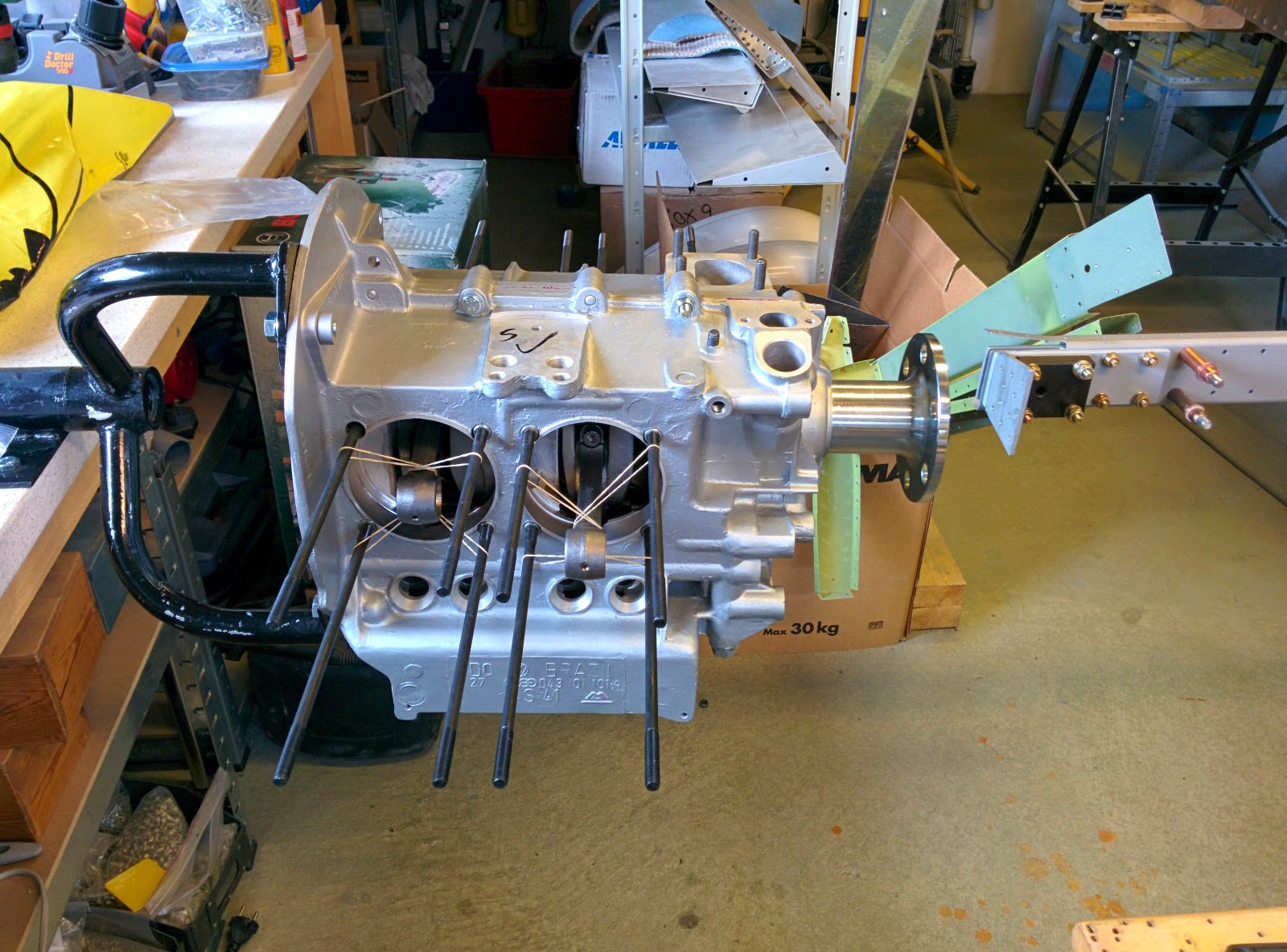
Put on the red gasket stuff, mated the halves and torqued according to the Aerovee manual.


Looked good, and the shaft rotates freely. However, when standing for 15-30 min it becomes a bit stuck. The same happens when moving back and forth 1-2 degrees repeatedly. To me it seems a bit to tight, but I will weight and hear what Sonex has to say.

Started with the cyinders and managed to break one piston ring. New ones ordered. Painted the cylinders black (thin cote of "barbecue black"). The cylinders will hopefully heat up enough to cure properly.


Tuesday, April 07, 2015

Engine

Continued with the engine. The pressure regulation valves had to be smoothed a bit to fit. To get them out after finding out they didn't move freely was a bit difficult. Had a metal brush with a plastic handle that fitted exactly, it did the trick.


Then the new conrods had to be trimmed so they didn't collide with the camshaft. Only a small amount of trimming was needed, but had to take it in steps, on and off and it took some time. I also weighed them, but the trimming didn't even show on the scale. They also had to be clean each time. Finally torqued the conrods according to specs.


Last summer I purchased a kit of tools for VW engines from Great Plains. The valve lifter holder proved to be really useful.


The heads from Mofoco looks awful. These have to be cleaned, trimmed and lapped. Purchased some paste and tools from Biltema.


Monday, January 19, 2015

Engine painting

Washed and cleaned the engine and masked off all open and machined places.


I also planned to paint it today using Auto-K engine paint. According to the web page at Mekonomen the paint is supposed to withstand 200 deg C, which should be more than enough for the casing, and I went down and bought 2 cans. But, I couldn't find any technical data sheet for that particular paint, and that was odd. The German site for the producer of the paint has a different paint, different part number, and didn't even have this "engine paint". Did some more research and found that Hagmans is the producer of "my" engine paint. According to the technical sheet there, the paint is only rated to 100-120 deg C, not 200 deg C. This is really annoying, paint is different and produced by different producers depending on where you live !!! Hagmans is a reputable brand, but "engine paint" reaching only 100 deg C ? I find this very strange, when the "original" paint from Auto-K is 300 deg C, and where does this faulty 200 deg C come from?

Now I'm not sure what kind of paint I will get. "Barbecue black", the "brand" Sonex themselves are using, is readily available, but I'm not too found of flat black, everything just becomes too dark too see. Biltema has some OK engine paint apparently, but is it really any good?

Paint is a real pain, more often than not. So far I have found and used two paint related things that works very well:


Silicone remover from Würth and Acid #8 from U-Pol (etch primer). They just work and the result is first class. I have ordered some boxes with gray 2K polyurethane to put inside the cockpit, I hope it works out well. I will find out during the next few days. This paint is industrial PU paint that Norbond fills up in rattle cans just before shipping. They must be used before 3-4 weeks.

Painting the outside of the AC is something I just have to start planning. My experimenting with rolling polysiloxane didn't really work out, impossible to get a smooth finish, and the polysiloxane cannot be polished (it gets white/flat and ugly). But now I have read about hobby car painters getting good results with Biltema polyurethane boat paint, spray and also with rollers. I have to try that, polyurethane sure can be buffed and polished, and I have heard nothing but good tales from boat owners using Biltema PU (even if some of their other paint is less than optimal).

The AeroVee engine parts made me scratch my head in disbelief today. The manifold enters the engine in two square channels. The engine on the other hand has two round channels. Why? this is simply unbelievable.


Thursday, January 15, 2015

Engine case preparation

Cleaning and filing is needed on the outside and the inside of the casing. This is what an inside out and upside down VW beetle engine looks like.


Saturday, January 03, 2015

Engine arrived

At last the engine arrived. Half a year after I ordered... Everything was there, engine, propeller, seat and lots of other bits and pieces.

Finished several small bits on the aircraft also.


Thursday, October 16, 2014

Fwd fuselage and engine

Riveted together the right side. Got message from Sonex today. My engine will be sent 17 november, a couple of months later than promised first, but I got more than enough things to do anyway, so no big deal for me.


Monday, July 28, 2014

Received stuff from Great Plains

Ordered a "toolkit" and an engine stand to mount the Aerovee and an oil cooler. Also ordered some books about the VW. A manual is included with the Aerovee, but some extra literature won't hurt.


It will take at least 10 weeks before I receive the engine and propeller.

Looked a bit closer at the engine/propeller calculations, and that equation is a bit simplistic. It is perfectly valid, but only with the same propeller blades, that is the blades only changes pitch and length, they do not change the length of the cord. With an increased diameter it is natural that the cord also increases. Different propellers can be completely different regarding cord and diameter. To chose a propeller just gets more complicated, and I am happy I chose the AeroVee.

I am also going for a completely "stock" engine with the AeroCarb. Then I know everything will work as it should, and I will found out for myself if modifications are needed or not. To make modifications with no basis in the actual status is not the correct engineering way to do things, and I am an engineer so :-)

Sunday, July 06, 2014

Engine - Conclusion and order

The order was sent today for an AeroVee :-)


Even though it comes in pieces and has to be built, the completion log of Onex'es clearly shows what is the certain path to a flying aircraft. About 95% of completed and flying Onex'es has AeroVee. What in the end became the deciding factor for me was the propeller. The propeller supplied by Sonex was is the best of several dozens they tried. A fixed pitch propeller has to fit the engine and the aircraft, and for another engine with different RPM range, to get this right has to involve lots of trial and error.

I have decided to use a Rotec TBI. But, depending on how the rules are implemented here in Norway, I may actually have to use the Aeroinjector initially, and then modify the engine later. The rules say an engine conversion must be used with the same ignition and fuel system as the "original" conversion, or bench testing will be necessary. A modification later on is not that strict. The thing is however, thousands of VW conversions are run all over the world with all kinds of ignition and fuel systems. After all this is a VW, just like any other VW.


The reason for a Rotec TBI is it has a pressure regulator that is essential for correct mixture during different g-loads, and is otherwise essentially an exactly like an Ellison TBI. A Rotec TBI does however require more fuel pressure than the Aeroinjector, so a pump or two will be required.


Engine and propellers

I think I have decided on the engine choice now, but some additional "brainwork" regarding engine and propellers makes the engine choice almost a "no brainer". The reason for this is that finding the right (fixed pitch) propeller for an arbitrary engine must be very difficult. Theoretically you must know the full performance graph of the engine, that is torque vs rpm for all power settings, at least at WOT and max continuous. Then you must know the performance of the aircraft (speed vs thrust) and the performance of the propeller (efficiency vs advance ratio). I don't know any of this, so if I should chose a "non standard" engine, I would have to get at least a ground adjustable propeller, or a CS propeller to have any chance of hitting it somewhere right. For a fixed pitch I would probably have to try several different ones, 10-20 maybe.

For instance. The power needed to drive a propeller is (for one single arbitrary air speed):

P = k * rpm³ * D⁴ * pitch

P is power, k is a constant depending on units and D is diameter.

Great Plains has in the catalog at page 39 a nice note about this. Their 1835 cc engine has a known horsepower of 60 at 3400 rpm. The propeller used for this engine has D = 52" and pitch = 42". I can use this as a base and plug in the numbers for some other engines and propellers. There are more to a propeller than pitch and diameter, but without advance ratio and efficiency this will have to do. The actual numbers here may be off, but the principle is right.

Engine (at max continous rpm/HP)HPrpmDpitch
GP 183560.034005242
GP 218070.034005249
AeroVee 2.173.134005444
GP 227676.434005446
Hummel 238779.734005448
Revmaster 2300 with recommended Prince propeller52.530005446
Revmaster 2300 with "correct" propeller79.230005660
Sauer 2400 UL79.727005872
ULPower 2600i81.828005771

The Aerovee with the Sensenich propeller will output 73 HP at 3400 rpm according to this. This is probably about right, because the larger GP 2276 cc shall output 76 HP, and will do so by slightly more pitch. The Revmaster is a different setup because it is designed to output 80 HP at 3000 rpm. With the recommended Prince propeller, it will only output 52 HP at 3000 rpm, so obviously Prince is wrong. A more "correct" propeller would be 55" diameter and 65" pitch. With the Sauer and ULPower, a usable propeller would be difficult to get right without also extending the landing gear/larger wheels due to their much lower rpm which requires larger D, or by adding more blades.

Regarding "propeller difficulties" the AeroVee is no problem. Sonex has done all the testing. The larger capacity GP and Hummel should also be relatively easy I guess. It is only a matter of adding some pitch. The Revmaster could be much more difficult. It is designed to run on lower rpm. The Sauer and ULPower would be even more difficult, and probably would need new landing gear to get a larger diameter propeller.

Saturday, April 19, 2014

Engines

I have been looking at engines again, set up some matrices to look at bore, stroke and cc. Below is a matrix of bore, stroke (mm) and displacement in cc of all the VW engines I know of.

Stroke [mm]
Bore [mm] 69 78.4 82 84 86 90
85.5 1585 1801 1883 1929 1975 2067
88 1679 1907 1995 2044 2092 2190
90 1756 1995 2087 2138 2188 2290
90.5 1775 2017 2110 2161 2213 2316
92 1835 2085 2180 2234 2287 2393
94 1915 2176 2276 2332 2387 2498
97 2040 2317 2424 2483 2542 2660


Then I substituted the displacement for engines


Here GP = Great Planes, H = Hummel, S = Sauer, L = Limbach and R = Revmaster. Surely the Sauer 2400 and the Revmaster 2300 with larger bore and larger stroke is more powerful than the AeroVee. The AeroVee is the smallest engine of the bunch. There is more to an engine than displacement, but larger bore and stroke more often than not means more HP and more torque.

The Limbachs and Sauers with 97 mm bore have a different casing than the others (the Sauer 2700 is no longer available, only the 2500). They use the "Wasserboxer" casing. This casing is originally made for 1900cc and 2100cc displacement, and obviously can accept at least 2700cc (97 mm bore and 90 mm stroke). The casing itself is not water cooled, only the cylinders and the top, but the casing is much stronger built than the air cooled casing. It is originally made of aluminum (I think), at least the Sauer and Limbachs are aluminum, but they make their own cases. Limbachs highest powered engines have water cooled top; The 100 HP L 2400 DFI/EFI, and the turbo engines, the 130 HP L2400 DT and the 160 hp L2400 DTX. Below are drawings of the air cooled cooled casing and the Wasserboxer casing.


Saturday, March 22, 2014

Engine

Watched/listened to the webcast from Sonex about the Aerovee engine.Very interesting to see how it became the engine it is today, and why it is a kit, not a finished engine. However, the lack of anything that can be called engineering in that engine, is all too obvious. All in all; a bit disappointing, still I am left with the impression that the engine is well tested in the field, the complete package is well thought through functionality vise, and that the engine will do what it is supposed to do. A good engine for the Onex? Yes.

Avgas UL91 is coming. Basically it is unleaded avgas 100LL and with octane numbers of 91 MON, 96 RON (whatever that actually means). Statoil is starting to sell this fuel in Norway. Avgas 91 UL is for all practical purposes aviation quality Mogas, and that can only be a good thing. The ability of the engine to run on UL91 is yet another additional important factor.

Name Type HP(max) RPM(max) cc kg Price € TBO [H] UL91 Mogas
Rotax 912 UL 80 2200 1300 72 € 12 142 2 000 Y 95
Rotax 912 ULS 100 2200 1400 75 € 13 499 2 000 Y 95
Rotax 912iS 100 2200 1400 75 € 18 329 2 000 Y 95
Sauer 1800 UL 68 3200 1835 64 € 7 845 1 600 Y 95
Sauer 2200 UL 85 3000 2234 66 € 9 567 1 600 Y 98
Sauer 2400 UL 100 3500 2332 75 € 10 574 1 600 Y 95
Sauer S 2100 ULT 110 3000 2161 76 € 13 586 1 600 Y 98
Limbach L2400 EFI 100 3000 2424 76 € 23 900 1 600 TBD 98
D-Motor LF26 92 3000 2690 57 € 12 600 1 500 Y 95
ULPower 260i 97 3300 2592 72 € 14 700 1 500 Y 95
ULPower 260iS 107 3300 2592 72 € 15 800 1 500 Y 98
D-Motor LF39 130 3000 3993 79 € 17 800 1 500 Y 95
ULPower 350i 118 3300 3503 78 € 18 800 1 500 Y 95
Limbach L2400 EB 84 3200 2424 82 € 19 500 1 400 TBD 98
Revmaster 2300 85 3200 2331 77 € 5 729 1 200 TBD 98*
Verner Scarlet 7H 110 3500 4127 82 € 11 990 600 Y 95
Hummel 2400 85 3600 2400 76 € 4 850 0 TBD 98*
AeroVee 2.1 80 3400 2180 73 € 5 083 0 TBD 98*
Great Plains 2300 80 3600 2276 75 € 5 199 0 TBD 98*
AeroVee 2.2T 100 3400 2180 80 € 7 266 0 TBD TBD
Viking Honda 110 2300 1500 81 € 9 439 0 TBD 98
Jabiru 2200 85 3300 2200 64 € 11 263 0 Y 95
Jabiru 3300 120 3300 3300 84 € 14 460 0 Y 95

* with reduced compression ratio, and thus reduced HP and efficiency.

A tiny bit too early for a conclusion. But the Rotax, D-motor, Viking, Limbach, Verner is realistically no longer options for me. It will be too much work to redesign everything firewall FWD. Limbach is too costly etc. From the other manufacturers I have received very positive correspondence about how to proceed and what kind of help I can expect. Sauer will be a drop-in replacement, with only minor modifications. ULPower have a guy selling motor mounts, etc. The list is therefore shortened to:

Name Type HP(max) RPM(max) cc kg Price € TBO [H] UL91 Mogas
Sauer 2200 UL 85 3000 2234 66 € 9 567 1 600 Y 98
Sauer 2400 UL 100 3500 2332 75 € 10 574 1 600 Y 95
ULPower 260i 97 3300 2592 72 € 14 700 1 500 Y 95
ULPower 260iS 107 3300 2592 72 € 15 800 1 500 Y 98
ULPower 350i 118 3300 3503 78 € 18 800 1 500 Y 95
Revmaster 2300 85 3200 2331 77 € 5 729 1 200 TBD 98*
AeroVee 2.1 80 3400 2180 73 € 5 083 0 TBD 98*
Great Plains 2300 80 3600 2276 75 € 5 199 0 TBD 98*
AeroVee 2.2T 100 3400 2180 80 € 7 266 0 TBD TBD
Jabiru 3300 120 3300 3300 84 € 14 460 0 Y 95

To achieve 80/85 HP on the american VW conversions, I will have to use 100LL. A fuel that may not be available for much longer. All the other engines runs equally well on UL91 and Mogas.

Saturday, March 01, 2014

Engines

Which engine to get is a hard nut to crack. I have updated my list and also included TBO. The reason is that the geography in Norway is very different from the European or American mainland. Good emergency landing spaces are far apart, 99% of the country is either woods, mountains or water, and none of those are good places to land in an emergency. I have to be somewhat lucky to survive, very lucky not to be injured and extremely lucky not to wreck the aircraft. Having flown only in Norway, mostly with certified Lycoming/Continentals or the ever-running Rotax, I haven't given it that much thought until I the engine stopped in a Piper Pawnee last year. I was extremely lucky to be able to glide back to the airfield and make a good power off landing with no damage whatsoever, but will I ever be that lucky again? From a practical point of view surviveability is handled in one of three ways for a single engine aircraft.

  1. A very reliable engine.
  2. Low impact velocity and or low kinetic energy (low stall speed and low weight).
  3. Emergency ballistic system or parachute.
It is obvious from the above list that the single most important factor to protect pilot and airplane is a reliable engine combined with good airmanship (always look for emergency landing spots etc). 2 will most certainly help regarding both surviveability and damage to the aircraft if the engine stops. The Onex do not have a particularly low stall speed, but the weight is low. Number 3 I am not sure is such a good idea at all in relation to the risk of engine stopping. I see 3 as a solution to other cases such as the risk of colliding in gliders or perhaps mechanical failure of the aircraft structure when doing aerobatics.

The only meaningful obtainable number regarding the reliability of an aircraft engine is the TBO. TBO is not the same as MTTF, but it is correlated. A set TBO means the MTTF is well within acceptable limits, if the engine is maintained properly and is operated within the TBO. My general experience also suggests that Lycoming, Continental and Rotax are extremely reliable engines, and these three all have a TBO of 2000+ hours.

With this in mind, the choice of engine becomes more interesting. TBO will be a number to take into consideration. Originally my position was to find an alternative to the Aerovee, one that was not too costly and one that I didn't have to put together myself. Today my position is in fact to find good and relevant reasons (excuses?) for not installing a Rotax 912. This means my engine alternatives have changed and have narrowed down to Rotax, Sauer and ULPower with Jabiru 2200/3300 as possible options.

Name Type HP(max) RPM(max) cc kg Price € TBO [H]
Rotax 912 UL 80 2200 1300 72 € 12 142 2 000
Rotax 912 ULS 100 2200 1400 75 € 13 499 2 000
Rotax 912iS 100 2200 1400 75 € 18 329 2 000
Sauer 1800 UL 68 3200 1835 64 € 7 845 1 600
Sauer 2200 UL 85 3000 2234 66 € 9 567 1 600
Sauer 2400 UL 100 3500 2332 75 € 10 574 1 600
Sauer S 2100 ULT 110 3000 2161 76 € 13 586 1 600
Limbach L2400 EFI 100 3000 2424 76 € 23 900 1 600
D-Motor LF26 92 3000 2690 57 € 12 600 1 500
ULPower 260i 97 3300 2592 72 € 14 700 1 500
ULPower 260iS 107 3300 2592 72 € 15 800 1 500
D-Motor LF39 130 3000 3993 79 € 17 800 1 500
ULPower 350i 118 3300 3503 78 € 18 800 1 500
Limbach L2400 EB 84 3200 2424 82 € 19 500 1 400
Verner Scarlet 7H 110 3500 4127 82 € 11 990 600
Hummel 2400 85 3600 2400 76 € 4 850 0
AeroVee 2.1 80 3400 2180 73 € 5 083 0
Great Plains 2300 80 3600 2276 75 € 5 199 0
Revmaster 2300 85 3200 2331 77 € 5 729 0
AeroVee 2.2T 100 3400 2180 80 € 7 266 0
Viking Honda 110 2300 1500 81 € 9 439 0
Jabiru 2200 85 3300 2200 64 € 11 263 0
Jabiru 3300 120 3300 3300 84 € 14 460 0

Engines with no TBO (zero TBO) runs in a state of "on condition". This is the same state as a Lycoming/Rotax that has exceeded its TBO runs in. What does this really mean? Well, this is basic maintenance and reliability theories in action in real life. An engine that runs within its TBO has an MTTF or MTBF that is constant and known. That is, as long as the engine is operated and maintained according to the factory documents,  the failure modes are known and happens so seldom that the risk is acceptable. The risk of sudden catastrophic failure of the engine parts (considering everything else is OK) is non existent from a practical point of view. When exceeding the TBO, the wear and tear on the engine starts to affect the reliability and any number of random things may happen at any time.

A TBO assures the engine will be reliable within its TBO, with a predetermined and very specific set of maintenance. With no TBO the engine can also be just as reliable, theoretically, but you have no idea what kind of maintenance is needed, or how often you have to do it. With no TBO, it runs "on condition". For a Lycoming this is OK for a limited time because the large number of engines in operation has limited the things to look for to a few points during condition inspection. For an engine that is put together by random aftermarket auto parts with no track of the origin, you have no idea, literally. You have no idea what to look for, thus no idea how to maintain it to assure it will run without failure the next hour.

So, an engine with a TBO is a world of difference better than an engine with no TBO, anyone saying differently don't know what they are talking about. It is better because you know how to maintain it, you know what to maintain and you know when to maintain it to be sure it will run without problems the next hours.

For practical purposes this means that a VW engine wizard will have no problems operating and running a VW aero engine conversion, and it will be every bit as reliable as a Lycoming. He knows what to look for, he knows what parts are OK, which aftermarket manufacturers are OK, how long each part last and so on. He will always be one step ahead of any failure waiting to happen. Myself, I am no VW engine wizard, I am no [any engine] engine wizard. So the only way for me to achieve a reliable engine is an engine with a TBO and a specific maintenance schedule within that TBO.